What we’ll cover…
- This guide covers how to choose the right electric radiator wattage and size for your room, including heating requirements, efficiency, smart controls, and options from the BestHeating range.
What size electric radiator do I need?
Choosing the right size electric radiator is essential for keeping your home warm and energy-efficient – but it’s also one of the most misunderstood steps in the buying journey.
This guide explains everything you need to know about electric radiator sizing, how heat output really works, and why the element’s wattage doesn’t always tell the full story.
Important note on electric radiator heat output
Not all 1500W electric radiators will heat your room in the same way.
In fact, many of our glycol-filled electric radiators (which use a sealed heating element and thermal fluid) are limited to a surface temperature of around 60°C. This makes them energy-efficient and safe – but it also means the heat output is not equal to the electrical wattage of the element.
Why this matters
While it might seem logical to assume that a 1500W electric radiator produces 1500W of heat (or around 5,118 BTUs), that’s not how they actually perform in real homes.
Instead, you should size your electric radiator based on the Delta T30 BTU rating of the hydronic version of the same radiator.
This gives a much more accurate reflection of the heat you’ll feel in the room.
How to calculate the right size for your space
1. Use our BTU Calculator
Head to the BestHeating BTU Calculator and enter your room dimensions, insulation quality, and window count.
This will give you the BTU requirement needed to comfortably heat the space.
2. Match that requirement to the Delta T30 output
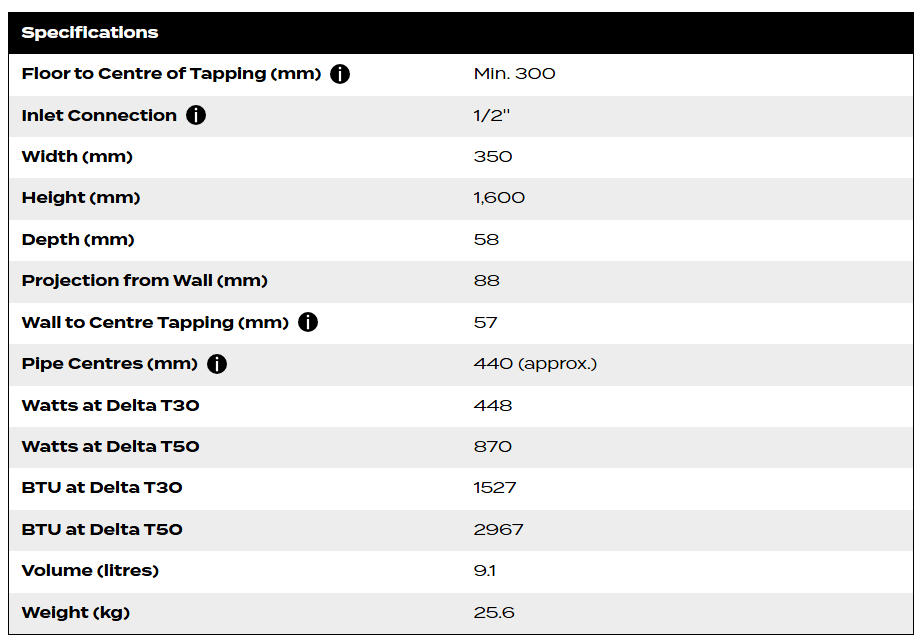
Instead of using the electric radiator’s element wattage, check the BTU output at Delta T30 for the hydronic equivalent.
This is especially important for glycol-filled electric radiators.
You will find the Delta T30 number in the spec table of every hot water radiator listing.
Why element wattage can be misleading
Let’s say you’re considering the Milano Windsor Electric Column Radiator.
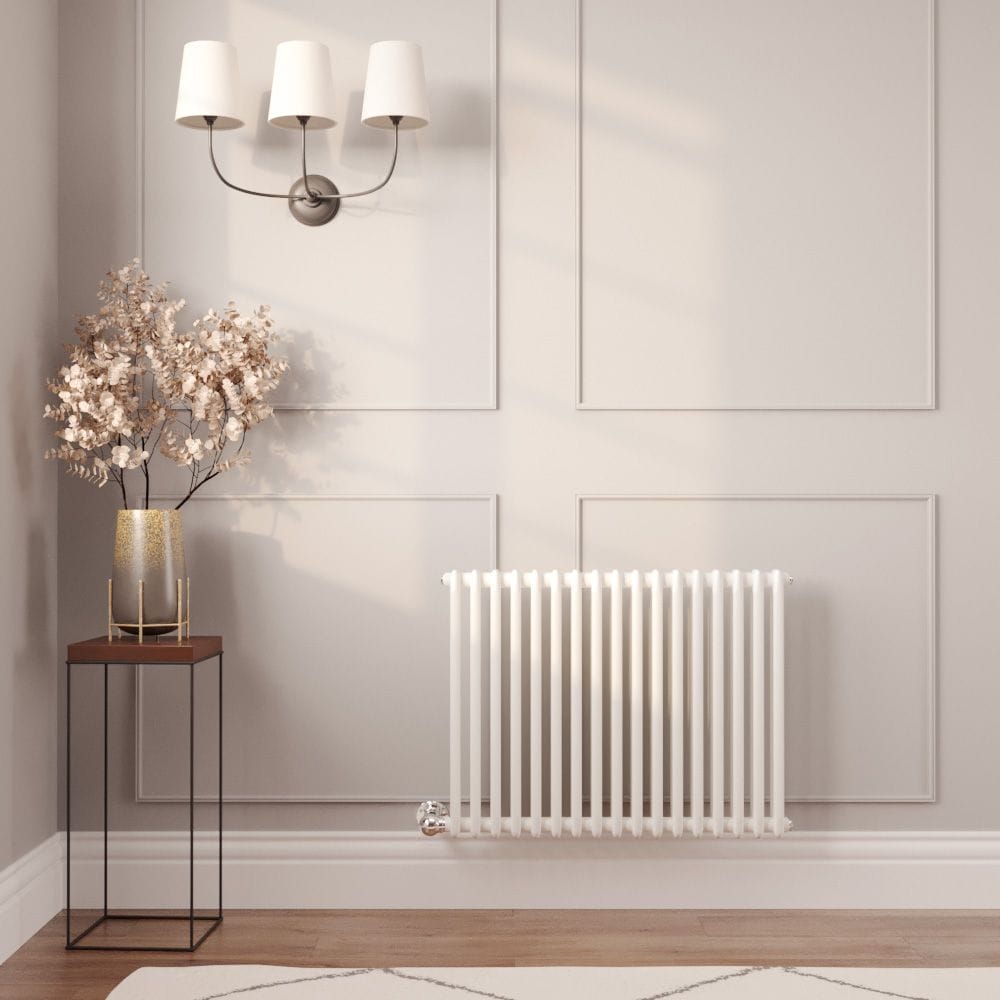
It uses a 1500W heating element, so you might think that, 1500W x 3.412 = 5,118 BTUs per hour (This is the theoretical output based on power consumption.)
But in real-world use – the hydronic version of this radiator – the TRUSH032 – has a Delta T30 BTU output of just 2,610 BTUs.
That’s nearly half the expected heat output.
So if your room needs 5,000 BTUs to stay warm, this radiator would be underpowered – even though the element wattage seems high enough.
How to choose the right electric radiator
When browsing electric radiators –
– Look for the Delta T30 BTU rating of the hydronic / plumbed version.
– Don’t rely solely on the heating element’s wattage.
– Use the BTU calculator and size up slightly if you’re unsure – it’s better to have a little extra heat than too little.
If you need help converting BTUs to Watts, use this simple formula –
1 Watt = 3.412 BTUs per hour
Or use our BTU Calculator to do the hard work for you.
Shop radiators by output
Once you’ve worked out your BTU requirement, you can browse electric radiators by realistic output –
– Electric Radiators for small rooms
– High output electric radiators
– Smart electric radiators
Look for the “BTU at Delta T30” or in the specifications for an accurate comparison.
Final tips
– Element wattage doesn’t equal heat output. Always check the Delta T rating.
– Glycol-filled radiators perform more like central heating, not plug-in heaters.
– Contact our team if you’re unsure – we’ll recommend the correct radiator for your space.
Need help sizing your radiator?
Speak to one of our heating experts today or use our BTU Calculator to get started.
Frequently Asked Questions
BestHeating offer a number of electric radiators with a width of 200mm, representing the slimmest models of our collection.
One such example is the Milano Windsor White Traditional Vertical Electric Triple Column Radiator, with dimensions of 1800mm x 200mm.
No. There are a wide variety of electric radiators available in an immense choice of sizes, shapes and styles.
Our full Advice Centre blog, Should You Buy An Electric Radiator, offers a full insight into this particular type of heating device.
There is no strict rule, but you can get the utmost levels of energy efficiency out of electric radiators by programming them to alternate preferred temperatures.
For instance, you can set a temperature for when the room is in use (comfort temperature) and a different one for when it is unoccupied (economy temperature).
That way, your electric radiators won’t expend extra energy unnecessarily, helping to keep your heating costs as low as possible.
All electric radiators from BestHeating are filled with a thermodynamic fluid called glycol, which enables them to operate with the utmost efficiency.
Glycol is used because it is excellent at retaining and transferring heat, and incorporates an anti-corrosion inhibitor to prevent rusting.
Further information can be found in our blog, What’s Inside an Electric Radiator?

John Lawless is SEO Manager at BestHeating and a recognised expert in home heating. With over a decade of experience in the industry, he blends technical insight with practical advice on everything from energy efficiency to radiator design, and more. John’s work has featured in national media and leading home & garden publications, and he leads the editorial strategy for the BestHeating Advice Centre – helping homeowners make smarter heating choices with confidence.