Contents
ToggleWhat we'll cover...
In this comprehensive guide, we’ll discuss what kettling is, the distinctive rumbling or whistling sound when hot water is boiling within your heating components. We’ll cover what causes kettle-style noises – primarily limescale and mineral deposits leading to limited flow, and offer tips on how to identify the issue and work out whether it’s a boiler-based or radiator-based noise, plus diagnostic checks you can perform yourself.
Furthermore, we’ll include a step-by-step fixing guide and provide advice on when professional help is required, and deliver an outline of DIY and professional costs for flushing, drainage and filter repairs and installations. We’ll also touch upon prevention strategies and maintenance measures to avoid any kettling problems in the future.
What is kettling?
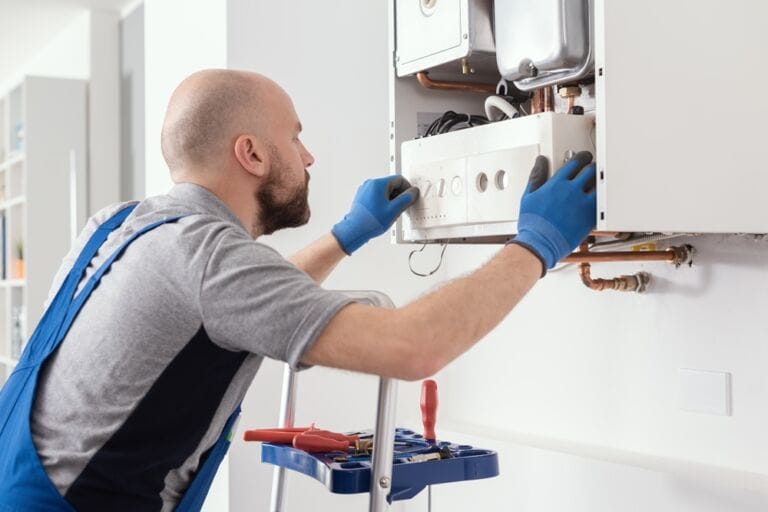
Kettling refers to the noise your boiler (or sometimes radiator) makes when water is overheating and transforming to steam in part of the system.
Hearing sounds emerging from your boiler, like a kettle whistling or your radiators rumbling, can understandably be alarming – but it’s more common than you probably imagine. And while it may not be an immediate safety hazard, it can shorten your boiler’s life, raise energy bills, and lead to costly repairs if left untreated.
As John Lawless, head of content at BestHeating explains: “Kettling is typically a warning sign – your system is working harder than it should. Fixing it early saves money, hassle and stress.”
So what, exactly is happening? If you hear kettling, the following process is occurring:
- Restricted water flow
- Hotspots form
- Water begins to steam locally
- Rapid expansion causes a vibration or “kettling” sound.
It’s typically most clearly audible in boilers, but can also manifest in radiator circuits on occasion as well.
Essentially, if your boiler sounds like it’s boiling the water inside itself (instead of quietly circulating), you’re likely dealing with kettling.
What causes kettling in boilers and radiators?
Limescale/mineral build-up
According to HVAC: “One of the leading causes of kettling is limescale buildup within the unit… if you consistently hear these noises, contact a professional.”
In hard-water areas in particular, minerals like calcium and magnesium deposit on heat exchanger surfaces or pipework, reducing flow and increasing resistance. This results in hotspots and steam.
Heatable states: “A particularly common cause … is the accumulation of limescale and ‘sludge’ in the heating system.”
Sludge accumulation (magnetite, corrosion products)
Although limescale is the prime culprit, sludge build-up from rusted system components or old systems can also restrict water flow and compound the issue.
Low flow/pressure and poor maintenance
Choosing the right radiator size isn’t purely a technical detail – it’s one of the most important aspects in your ultimate decision when upgrading or planning your home heating. Get it right, and your rooms will heat up quickly, evenly, and efficiently. Get it wrong, and you could find yourself battling cold spots, longer heat-up times, and unnecessarily high energy bills.
This complete radiator size guide is designed to remove the guesswork. It offers room-by-room BTU guidance, practical sizing tables, and expert insight into how different radiator types will perform in real home settings – whether you’re heating a compact bathroom, a busy family kitchen, or a large open-plan living space.
Is boiler kettling dangerous?
Short-answer: Not usually immediately dangerous, but you should act. Over time, unchecked kettling reduces efficiency, drives up fuel bills and may damage the heat exchanger, possibly causing leaks, lock-outs or complete failure.
If you spot smoke, major leaks, or the boiler keeps tripping, switch it off and call a Gas Safe engineer.
How much does it cost to fix a kettling boiler?
Repair type | Suitable for | Cost range UK (2024-25) | Source |
Chemical cleaner + inhibitor (DIY) | Mild deposits, good pressure | £15-£30 for product | ToolStation/Screwfix pricing |
Professional magnetic filter install | Sludge/iron debris issue | £165-£300 fitted | Hamuch guide Manchester Plumbing and Heating (Sale) |
Professional power flush | Heavy sludge or scale deposit | £300-£800 depending size & radiators Checkatrade | Checkatrade, Tradesmencosts |
Full descaling / exchanger repair | Severe limescale, frequent lock-outs | Quote required; may approach full boiler replacement | SPS Mechanical SPS Mechanical |
These figures give a rough estimate to work with when planning for repairs.

A step-by-step guide to fixing kettling
For DIY work to tackle kettling, only safe owner checks and mild treatments should be attempted. Anything involving internal boiler parts, high pressure flushing, or gas systems must be handled by a Gas Safe engineer.
Step 1: Confirm the diagnosis
- Listen carefully: Is the noise emerging from the boiler casing, the pipework, or individual radiators?
- Check system pressure: a typical cold system should read 1-1.5 bar. Too low or too high? That might affect water flow and cause noise.
- Bleed radiators if they are cold at the bottom or producing gurgle/air noise.
- Location & water quality check: Are you in a hard-water area? Mineral deposits are more likely in such locations.
Step 2: Check for leaks and circulation issues
- Inspect visible pipework, boiler joints, PRV (pressure relief valve) discharge pipes.
- If leaks are identified, pressure drops can slow down circulation and trigger kettling sounds, at which point you should call an engineer.
- Confirm the pump is running, valves are open and heating zone controls are correct.
Step 3: Reset the boiler and observe
- Many condensers will lock out if overheating occurs. Use the boiler’s reset button as indicated in the boiler manual.
- After resetting, keep an eye on the system while it fires back up. If noise persists immediately, move onto the next step.
Step 4: Use a chemical cleaner and add inhibitor
- Choose a reputable system cleaner (e.g. Fernox F3) and chemical inhibitor (such as Sentinel X100) and follow product instructions to apply.
- Drain, flush (or run the cleaner through the system for the recommended period), and refill with inhibitor included.
- Monitor results – does noise reduce? Are radiators warming up evenly? If not, proceed with professional assistance.
Step 5: Professional intervention
If DIY cleaning can’t resolve the issue:
- Request a heating engineer descaling of the heat exchanger or a power flush of the entire system. Checkatrade estimate a power flush will cost somewhere between £300 and £800 depending on the size of the system.
- Consider adding a magnetic filter or scale reducer (see prevention section).
- Ask for a full system review to confirm or diagnose any underlying issues (weak mains pressure, aging boiler etc.).
How to prevent kettling in the future
There are a few measures that can be taken to prevent kettling from occurring again in the future.
Install a magnetic system filter
Captures iron oxide and sludge for the protection of internal boiler parts. Experts in hard-water areas, such as Manchester Plumbing and Heating, recommend this as standard.
Fit an inline limescale reducer/conditioner
Particularly useful in hard-water zones, an inline limescale reducer or conditioner can be installed on cold mains prior to the boiler. This will help to reduce future scale formation and therefore kettling potential.
Maintain water treatment and regular servicing
- Ensure chemical inhibitor remains at correct levels (many installers will check this as part of an annual boiler service).
- Ask for a scale check during service.
- Bleed radiators annually and flush the system every 5-10 years, depending on water quality in your specific area. Tradesmen Costs allows you to easily retrieve tailored quotes for professional work related to your location and the job at hand.
Other preventive tips
- Fit a hard-water sensor if local hardness is extremely high (300+ mg/L). You can check with Aqua Cure’s UK hard water map.
- Keep boiler flow temperature within manufacturer settings to reduce the risk of scale build-up.
- Consider the use of water softener if living in an extremely hard-water region. Be wary of added costs in this situation; Checkatrade outlines a price point of anywhere from £500 up to £1600 for water softener systems, plus £350 for installation.
Frequently Asked Questions
How to fix a kettling radiator?
If a kettling noise is emanating from a radiator rather than your boiler, check for cold spots, bleed air, and consider a chemical flush or power flush of that loop.
Should I turn my boiler off if it’s kettling?
If the noise is extreme and persistent, the boiler lockouts or you notice leaks – switch it off and call an engineer. For mild noise, you can monitor and perform the DIY steps listed earlier in the article.
Can a kettling boiler be repaired?
Yes – often via descaling, power flushing, and/or filter installation. But if the heat exchanger is badly damaged, a full replacement may be required.
Does bleeding a radiator stop kettling?
Not if kettling is being caused by limescale or hot spots. Bleeding a radiator helps with air issues; when deposits are the cause, deeper cleaning is required.
How much does it cost to fix a kettling boiler?
Checkatrade offers a range of kettling boiler fix estimate costs as follows: DIY chemical £15-£30; magnetic filter £165-£300; power flush £300-£800+ depending on system size.
Avoid kettling issues with BestHeating help
Kettling – that alarming whistling noise from your boiler or radiator – is more than an annoyance. It’s a warning sign that your system is under strain. Positively, many cases are preventable or verifiable through DIY measures, so you can be proactive and don’t need to wait for a system breakdown.
Quick recap:
- Identify if the noise is truly kettling (vs air/gurgle).
- Run through the DIY steps (check pressure/leaks, use chemical cleaner/inhibitor).
- For persistent problems, invest in professional solutions (flushing, filters, or descaling).
- Prevent future recurrence with yearly servicing, magnetic filtering, and scale reducers – particularly in hard-water areas.
If you’re unsure or the system is older (10+ years) or under warranty terms, you should schedule a Gas Safe engineer inspection. The BestHeating Advice Centre features a plethora of resources outlining how to get the best out of your heating system, with maintenance tips, upgrade suggestions and much more.
Stay ahead of the problem and keep your system running quietly, efficiently, and reliably. And don’t forget to let us know about your best home heating solutions in the comments, or via our social channels on Instagram, Facebook or X.

John is a Research Specialist for the Best Heating Advice Centre, where for over nine years he has dedicated himself to demystifying home heating for our customers. He specialises in creating clear, data-driven guides and how-to articles by collaborating directly with our team of certified heating experts and product engineers.
His work, built on a foundation of journalistic research, has helped millions of readers make confident and informed decisions about their home heating. When he’s not breaking down the heat output differentials from radiators to heated towel rails, John fancies himself as a fine football and music connoisseur.