Contents
ToggleWhat we'll cover...
This guide will break down exactly how much an electric fire costs to run, whether it can prove cheaper than using your central heating, and how zoned heating can help you cut your energy bills without sacrificing comfort.
You’ll learn how electric fires work, why their 100% efficiency makes them ideal for targeted warmth, how much electricity they use, and how to calculate their running costs using your own tariff.
We’ll also compare electric fires with whole-home central heating, explore the benefits of LED flame-only modes, and detail when an electric fire is the most cost-effective choice for your home.

What is an electric fire?
Especially in comparison to other heating options, electric fires offer an energy efficient way to add instant warmth and a cosy glow to your living space without having to heat your entire home. They offer a gorgeous modern aesthetic that will seamlessly upgrade the look of any living room area. But you may be thinking, are electric fires expensive to run?
We’ll delve into the running costs of an electric fire here so you can work out exactly how much it will add to your electricity bill. Plus, we’ll explore the idea that electric fires are a flexible and efficient tool for zone heating, allowing you to keep your energy usage and your bills in check.
Is it cheaper to run central heating or an electric fire?
An electric fire is a fantastic alternative to switching on the central heating, and is generally cheaper to run, but only if you use it to heat one or two rooms for a short amount of time. However, for heating the entire house over a longer period, central heating is typically cheaper overall. The reason for this dual answer all comes down to usage and is the concept of zone-heating and whole-home heating.
Zone heating – this refers to concentrating warmth on a specific area. So, if you’re only using the living room during the evening, why pay to heat the upstairs? Using an electric fire will quickly and efficiently warm up one room, which means you avoid the cost of firing up a boiler to heat up every radiator in your house. Therefore, an electric fire becomes the cheaper and more sensible choice for targeted use.
Whole-home heating – this is the continuous and consistent heating of an entire house via a central heating system. Gas is around 3-4 times cheaper per unit than electricity and is why gas central heating wins the race when heating spacious areas. The downside to using the central heating to warm one room is that you are still paying for the boiler to heat the water that travels through pipes around your house, and those pipes require the radiators in unused rooms to be on, even slightly, leading to wasted energy.
Here you can compare the running costs and efficiency of an electric fire versus a central heating system:
Key: 1 kW = 1000W / 2 kW = 2000W etc.
Heating Option | Typical Power/Usage | Unit Rate | Estimated Cost per Hour | Ideal Usage Scenario | Notes |
Electric fire (zone heating) | 1-2 kW (e.g., 2 kW for 1 hour) | 25.73 p/kWh (electricity) | 51p per hour for 2 kW × 25.73p = 51p | Heating one or two rooms for short periods | 100% efficient at point of use; best for “spot heating”. |
Gas central heating (whole home) | Equivalent output for whole house (e.g., 10 kW+) | 6.24 p/kWh (gas) boiler efficiency – 80% | For 2kW equivalent: 2 kW ÷ 0.8 × 6.24 p = 15.6 p per hour | Consistent heating of whole home over longer period | Lower per-unit cost because gas is cheaper; good for larger-scale use. |
Sources: Energy Guide, Ideal Home

Electric fires vs central heating: Key takeaways
In line with the facts and figures presented in the table above, there are a few key takeaways we can gleam from the electric fires vs central heating running costs debate…
- Electric fires cost more per hour to run than the comparable output from a gas-fed central heating system because electricity unit rates are significantly higher than gas.
- Electric fires are viable and often most cost-effective when used for zoned heating systems (i.e., heating one room for a short time).
- For a whole-home heating scenario, gas central heating tends to be cheaper to run overall because gas costs are lower and the system is designed for the sustained heating of multiple rooms.
- The efficiency of electric fires is near 100% at the point of use (no flue losses), but the cost of the “fuel” (electricity) is the limiting factor.
- Usage pattern is critical: the more rooms you heat via electric standalone units the quicker the costs add up, reducing their cost-effectiveness compared to central systems. That said, an electric fire will often be installed as a statement feature in a single room such as the living room or bedroom, so costs shouldn’t spiral too much in this sense.
Use our BTU calculator to calculate your heat output requirements, so you can create a perfectly warm room, increase the efficiency of your heating and take control of your energy bills whatever your decision.
Do electric fires heat up a room effectively?
Electric fires are ideal for zone heating and warming up small to medium sized spaces. Although they are 100% efficient at converting electricity into heat, electric fires do have a set maximum output, which is typically 1000W (1 kW) or 2000W (2kW). Even though this limits their overall power compared to a central heating system, it’s plenty for targeted use.
Why pay to heat your house with the central heating just so you can warm up the living room in the evening? An electric fire provides that instant cosy warmth right where you are. Plus, with the likes of electric fire media walls, you can create a stunning focal point for the lounge.

How much electricity does an electric fire use?
Electric fires are perfect for eco-conscious homeowners as they offer an energy efficient heating option, but how much electricity do they use? In short, not a lot and the most important point of all, is that electric fires are 100% efficient at converting energy to heat. Each single unit of electricity that passes through the heating element is turned into heat for your room and zero heat is lost as the fire does not require a flue, chimney or any ventilation.
What’s more, the heat and flame effect are totally separate. You can simply switch on the flickering ambience for pennies and enjoy the stunning visual effect year-round.
When you look at heating systems that burn gas or wood, a large amount of the generated heat is wasted. Gas fires and boilers typically reach about 90-95% efficiency with the remaining heat lost up the flue or chimney along with the combustion gases. With open wood fires, these can lose as much as 80% of the heat straight up the chimney.
At BestHeating, our electric heating is Lot 20 compliant. This legislation ensures that all newly manufactured electric heating products are designed to meet minimum efficiency standards, reducing emissions and helping homeowners save money on energy bills. For further information on this legislation, read our Lot 20 explained heating guide.
Enjoy energy efficient home heating with our smart heating accessories.

How to calculate the running costs of an electric fire
To work out electric fire running costs, you will need your most recent electric bill and the appliance details. Your electric bill details the unit price or unit rate and is what your supplier charges you per kilowatt hour (kWh). The amount of electricity needed to run a 1000W (1kW) appliance for an hour.
All electric fires have a power rating in kilowatts; this is the heat output and the amount of electric needed to run the fire for an hour.
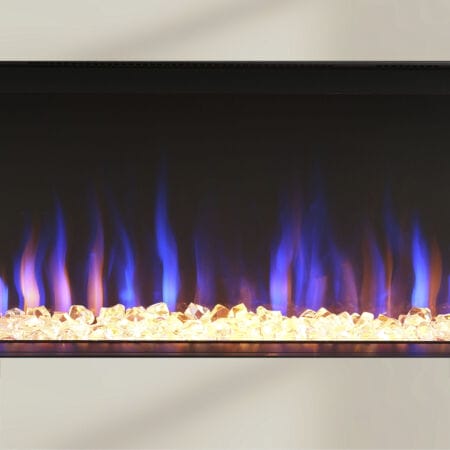
The most used feature in an electric fireplace is the flame effect. This is created using energy efficient LED lighting and with most electric fires, the flame and heater can be used independently. The total power of all LEDs, even in the largest of electric fires, is less than 30 watts.
To work out the exact running cost of an electric fire, use this simple calculation:
Cost per hour = electric fire heat output in kW x electricity unit rate per kWh
For example, the cost to run a 2kW heater at 30p per kWh will cost you 60p per hour:
2kW x 30p/kWh=60p per hour
And the cost to run a 1kW heater at 30p per kWh will cost you 30p per hour:
1kW x 30p/kWh=30p per hour
Make sure to check your latest energy bill for an accurate unit cost.

Choose BestHeating for electric fires
Are electric fires expensive to run? Particularly when used for zone heating and ambience, electric fires are an efficient and cost-effective way to stay warm. However, they are not suitable for heating an entire house and treating them as a replacement for your boiler means they will be costly to run.
Shop an excellent range of energy-efficient electric fires including electric stoves and media wall fires at BestHeating and bring a stunning focal point to your home. And don’t forget to show off your electric fire installations by tagging us on Instagram, Facebook or X.

John is a Research Specialist for the Best Heating Advice Centre, where for over nine years he has dedicated himself to demystifying home heating for our customers. He specialises in creating clear, data-driven guides and how-to articles by collaborating directly with our team of certified heating experts and product engineers.
His work, built on a foundation of journalistic research, has helped millions of readers make confident and informed decisions about their home heating. When he’s not breaking down the heat output differentials from radiators to heated towel rails, John fancies himself as a fine football and music connoisseur.